





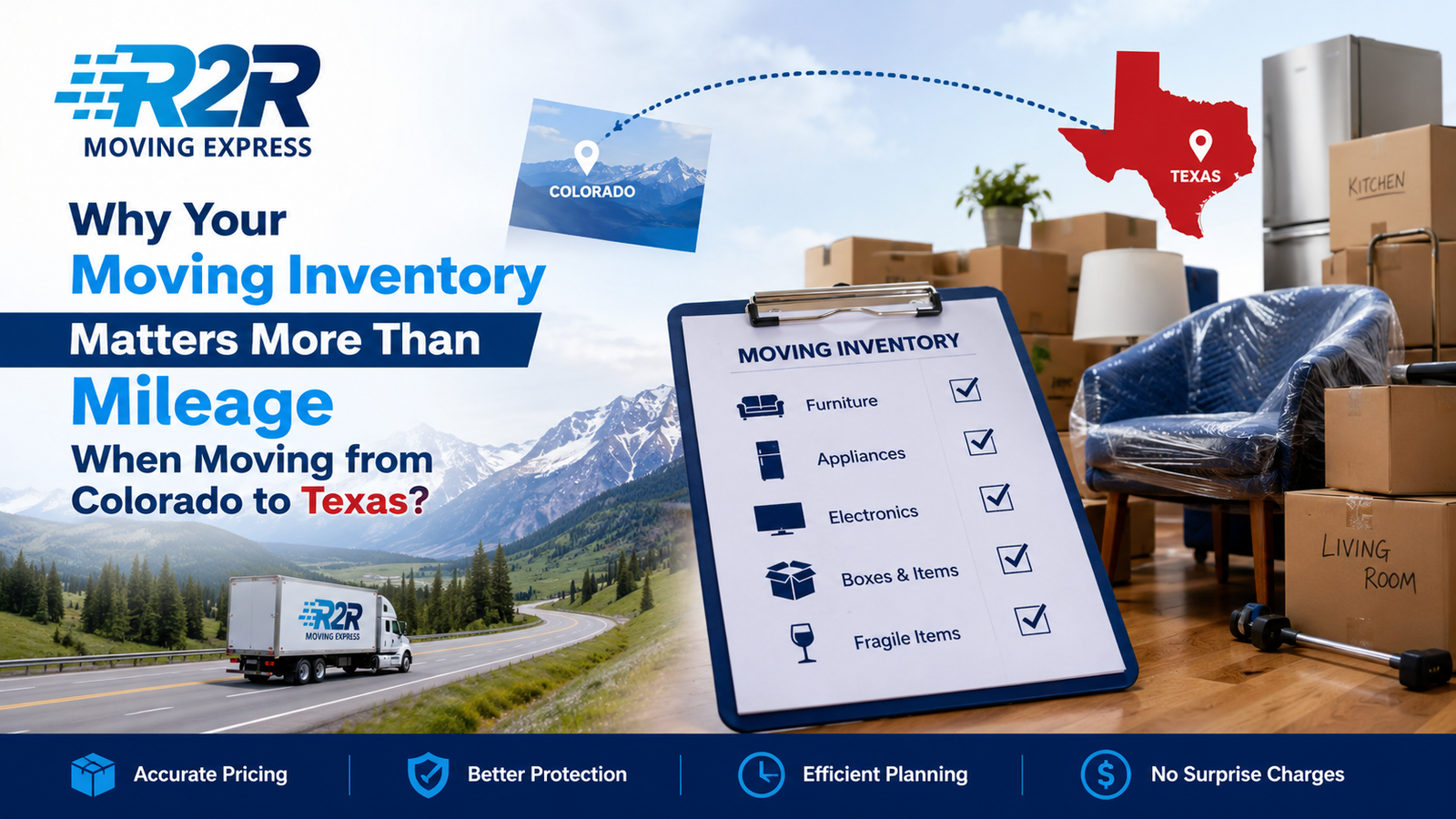
Summary: There are more factors than miles that go into a Colorado to Texas movers! Your Moving Inventory for your home may influence your truck space, labor needs, handling needs, equipment, and some overall complexity of your move. An accurate inventory prior to requesting a quote helps movers move efficiently and helps customers sort out any preventable items and moving day issues that would come about by having unnecessary items to move.
A moving truck does not care how many state lines it crosses nearly as much as it cares about what is inside it. Two households can move from the same Colorado city to the same Texas destination, yet their moving costs, truck requirements, labor needs, and timelines can be dramatically different.
That is why Colorado-to-Texas movers look beyond mileage when estimating a relocation. The distance establishes the route, but the inventory determines much of the work required to complete the move. Understanding this difference can help households prepare more accurately, avoid unexpected charges, and make better decisions about what actually needs to travel.
Your Inventory Determines How Much Truck Space You Need
Among the most practical applications of inventory is the size or capacity of the trucks. Furthermore, moving companies should calculate the space that they will require to park and to plan for the load before hiring the right moving truck.
The size of furniture, with different pieces adding up can make a difference in furniture dimensions. Even though your household items don’t look like they take up a lot of room, a sectional sofa, king-size bedroom set, large dining table, exercise equipment or just several bookcases can occupy a lot of cubic space.
On the other hand, if you have lots of boxes and don’t have a lot of big furniture then it can be more efficient to load your home.
A detailed inventory helps with movers more precisely determine the precise volume of the shipment and plan the truck to fit. This ensures fewer problems when it comes time to move, as you won’t have to worry about outfitting the moving truck with the car or loading procedure you want.
Heavy Items Can Change the Moving Equation
Factors other than volume need to be taken into account. Weight and handling is also a factor.
Large fitness machines, solid-wood furniture, washers and dryers, workshops and other equipment, pianos, refrigerators and safes may need specialized handling. Additional man power or equipment may be required to ship some items due to their size, weight, shape, and/or internal placement in the property.
Lifting a heavy safe down a tight staircase is very different to moving several light boxes from a garage. Labor hours have not been the same between Colorado and Texas, while the mileage is.
Such is the case for other interstate relocations. California to Washington movers must consider the actual moving complexities instead of just mileage when assessing moving.
An Accurate Inventory Helps Prevent Moving-Day Surprises.
One of the main issues with an incomplete inventory is the fact that things could change on moving day.
Assume your estimate includes standard furniture or boxes that the customer decides to put in, but an extra garage with tools, outdoor furniture, extra appliances, and 2 or 3 large storage items. This shipment may need more manpower, space, or adjustments in the loading plan.
A detailed inventory provides the moving company with more information prior to starting the move. Customers should determine the items they are going to be moving, such as the following items stored in:
- Garages
- Attics
- Basements
- Sheds
- Closets
- Storage units
- Outdoor areas
Honesty about the items will help you develop your moving strategy in reality.
Inventory Also Helps You Decide What Should Move
A moving inventory is not just a list for the moving company! It may also assist homeowners in saving on needless shifting costs.
Make sure to divide the belongings into three categories: things that need to be taken, things that you would keep if space allowed, and things that can be donated, sold, recycled or thrown away before receiving a final estimate.
The expenses of moving unwanted furniture across state lines may be greater than the replacement price after the move. This goes for any boxes that contain infrequently used household products as well.
If the shipment is reduced (if possible), it can be easier to pack, reduce the amount of truck space needed, reduce the loading time, and make the relocation process easier.
Build Your Inventory Before Requesting an Estimate
If you’re moving from Colorado to Texas, get ahead of the curve and begin your inventory a couple weeks prior to move day. Make note of large furniture pieces, appliances, housekeeping items, approximate box count, and items needing special attention.
Photos can also enable movers to see something that is too big or hard to deal with. If feasible, give a truthful response to stairs, elevator, narrow halls, parking limitations, and long carries from the property to the truck.
The better you fill out the information, the easier it is to make a realistic moving strategy.
Conclusion
Movers Conversion Code tells the movers how far the items they are moving must travel. They will know what it will actually take to get those things there based on your inventory. This can make a big difference when moving from Colorado to Texas and may involve considering space, labor, equipment, moving schedules, and the total moving expenses.
Looking for a Colorado-to-Texas mover? Contact Road 2 Road Moving Express for professional assistance with planning and transporting your household inventory.
FAQs
1. Why is the movement of inventory important?
When you are moving your digital files, knowing the volume of the inventory is important for determining how much truck space, labour, packing material, equipment and handling you will need for that move.
2. Is there any relation between moving costs and the number of boxes moved?
Not necessarily. While the number of boxes is important, other factors such as the size of the furniture, weight of the item, special items, labor to pack and unpack and volume of shipment can also factor into the estimate.
3. Should I include garage and storage items in my inventory?
Yes. Furniture, equipment, wiring, etc can be found in garages, attics, sheds, basements and storage units and greatly impact the overall shipment.
4. Does decreasing my stock levels reduce moving expenses?
Potentially. Eliminating excess or unnecessary items can decrease the truck size and/or labor used to ship items.
5. When should I create my moving inventory?
If possible, start several weeks prior to an anticipated move. This gives you enough time to sort out possessions, do a bit of cleaning, get all the specialty items sorted out and give them accurate information for the moving estimate.