



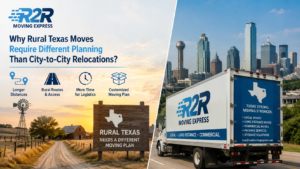

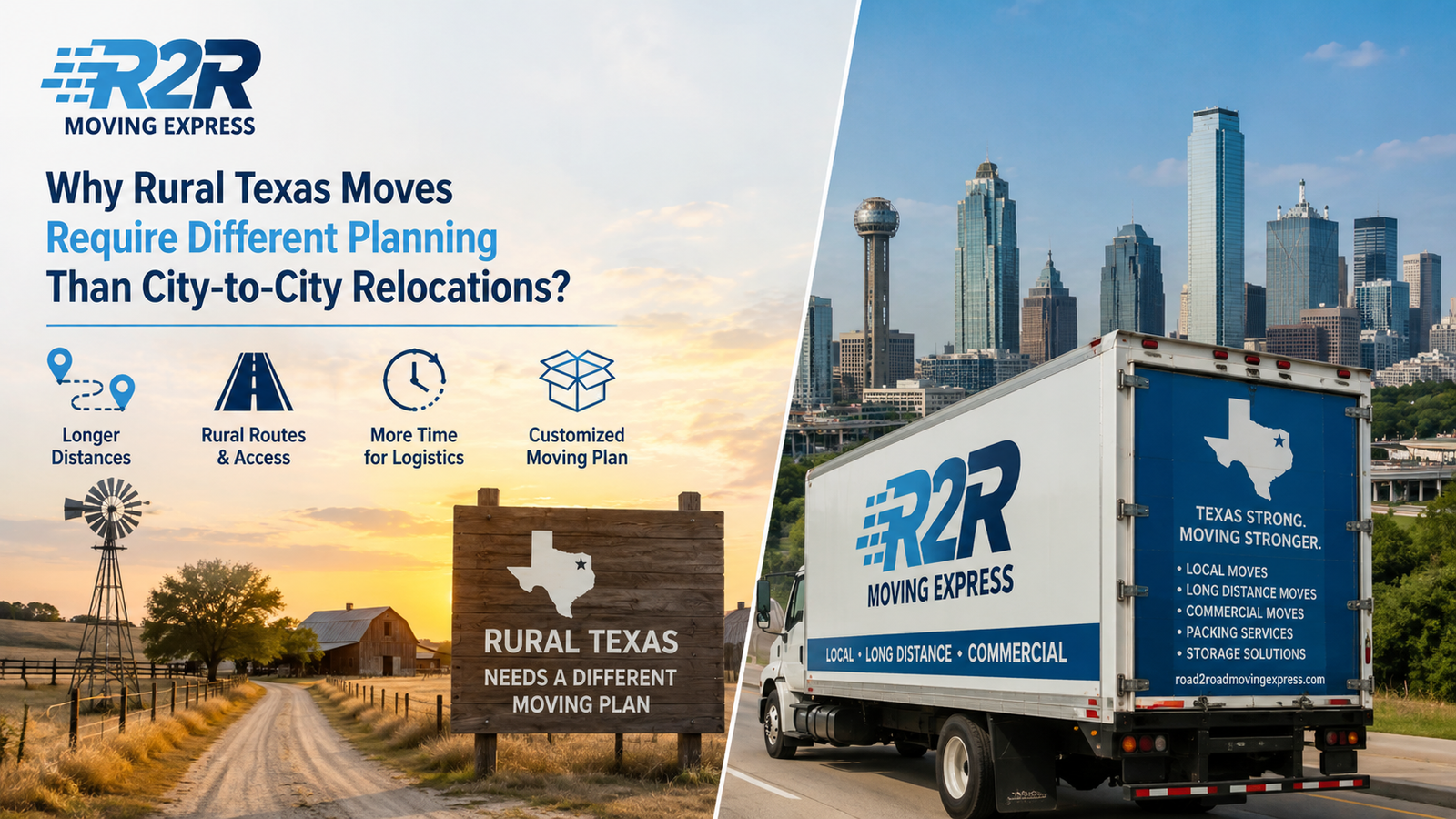
Summary: Moving to or from a rural Texas area is more than just driving to the nearest location. The volume of services, broken or gravel roads, access to property, unpredictable weather, gas availability, and large items may heavily influence the moving logistics. Proactive route planning, inventory, verbal communication, and scheduling decrease delays and help simplify the entire process of relocating to rural areas.
The distance may not look dramatic on a map, but the logistics can be.
That is why moving to or from a rural Texas property requires a different level of preparation than a conventional city-to-city relocation. Route accessibility, property conditions, equipment, timing, and even communication can influence whether moving day runs smoothly or becomes unexpectedly complicated.
Rural Distance Is Not the Only Factor
Rural Texas moves can be extended between towns, and there are not as many convenient stops.
A piece of property could be many miles off the main road and so have few or no cell phone reception, or not have access to services right away. Route planning is very important, particularly in this context.
Professional Texas long-distance movers must take into account other factors besides the simple distance between origin and destination. May have to assess road conditions, bridge restrictions, seasonal weather, property access, and the type of moving vehicle needed for the final approach.
Property Access Can Change the Entire Moving Plan
One of the main reasons why relocating to a rural area differs from relocating to an urban area is how the distance is covered in the final stages of the move.
The gravel driveway, steep incline, soft ground, tight turn, low-hanging branches, or private road may be an obstacle for large line trucks in a rural location. A single property may be super easy to pick up with a pickup, and be completely inaccessible to a moving company if it’s fully loaded when it arrives.
Homeowners should make sure their landlords know exactly about before they move in:
- Driveway width and surface.
- Elevated slopes or tight corners.
- Very steep slopes or turns.
- Gate dimensions.
- Low branches or obstructions above heads.
- To the right, there are bridges or weight limits.
- Distance of the home site to the road.
Locations where trucks can park, in an ungagged condition, with space for truck parking. Such information helps movers allocate the equipment and labor appropriately before they get to the home.
Fuel and Service Availability Require More Planning
In metropolitan areas, delays that are out of the ordinary can often be dealt with promptly. Routes might not be the same in rural areas.
Rest stops, service and parts shops, fast food and sleeping areas may be miles apart. A slight time lag can thus have repercussions on the whole timetable.
In case of a rural Texas relocation, planning for the transportation should include fuel stops, driving time, weather, and possible delays. Allowing for a reasonable amount of time in the schedule can alleviate stress for the moving company as well as the individual homeowner.
That’s why, when customers move in-house from another state, it is important that they choose a moving company that is familiar with Texas transportation requirements. While an Ohio moving company could be knowledgeable about the different methods used to do interstate moves, it may not know as much about the roads and property access concerns in rural Texas.
Weather Can Have a Greater Impact
Travel conditions in Texas can change in an instant. An unpaved driveway may be unusable during a rainy day, and extreme temperatures can impact people and equipment.
When moving in rural areas, planning the move with regard to the weather should start before the truck departs from the origin. A moving company may need to track weather predictions wherever they’re moving, which means they may also need to track the weather at the destination.
A trained moving company can evaluate if adverse weather will call for changes in arrival time, equipment, or loading procedures.
Communication Becomes More Important
Rural households could experience restricted cell phone coverage and be in areas with hard-to-use addresses and GPS directions that don’t always correspond directly to the last street that might be reached. Make sure detailed instructions are given prior to moving to avoid confusion.
You should give your homeowners a shared code for the gate, landmarks, alternate contact, road directions and any special access. If the property is hard to find, another point which can be clear is another point which can help the movers to come out by the destination easily.
Inventory Planning Matters Too
Moving to a rural area can be more than just chairs, couches and tables. Anything not found in an urban setting may be property in an extra urban location such as a workshop, shed, etc, agricultural equipment, outdoor furniture, tools and generators, and other large objects.
All those items may need extra labor, specialized handling, or other loading strategies. An accurate inventory at the planning stage will help movers determine the amount of truck space and personnel required for your moving needs.
When moving, it is important to inform the moving company beforehand about any large or unusual items. It is best to make sure to mention any large or unusual items ahead of time so there won’t be any unnecessary delays.
Conclusion
Being prepared is key when relocating to rural Texas. The appearance of a simple operation may actually present unusual challenges related to road, zone, weather, or access when it comes time to plan the operation.
Call Road2Road Moving Express before relocation day to discuss your transfer needs and organize them before you relocate to a rural or long-distance area.
FAQs
1. Why are rural Texas moves different from city relocations?
Examples of people moving from rural areas include those traveling through gravel roads or those with less access to public transportation, even though they live close to facilities such as hospitals and schools.
2. Should movers inspect a rural property before moving day?
More detail about the property will be key. Moving photos or measurements of driveways, gates, roads, etc. can help movers follow the right plan.
3. How does weather impact rural Texas moving companies?
Yes. Extreme heat can present extra challenges to workers or equipment, while the heat of the rain can create problems for unpaved roads and driveways.
4. What should I place on my moving company?
Enter the dimensions of the driveway, the roadway, and any conditions, the gate info, the access instructions for properties, in case there is anything too large, the person’s contact info, and any restrictions you know of.
5. Can an out-of-state moving company handle a rural Texas move? You can rely on an interstate moving company to handle the move, though the company’s experience with rural Texas driving routes and conditions for accessing the property can be very beneficial when making final arrangements for the move.